indie shorts mag
Émile V. Schlesser’s Backstage is a masterclass. A powerful narrative of an exploitative system, gender-reversed power dynamics, a gritting pull between age versus experience, Backstage, offers so many subtexts, that it warrants multiple views. Very few films explore these subject matters in feature-length, let alone in the short duration category. And, yet, Schlesser not only ingeniously crafts a dark and compelling tale around stardom, systemic manipulation, and the grey that exists between power and hunger, that by the end of the near 26:00-minute-long film, one is left with the uncomfortable, unsettling comeuppance that feels well deserved but not earned. It makes one ponder about the façade behind the grandeur, the cost that an artist pays to merit the limelight.
Lukas (Jonathan Joél Albrecht) is the lead, cast opposite Vero (Jil Devresse), in a two-person play directed by the famed theatre director Cosima Lambrecht’s (Sascha Ley). That the star of her previous play Philippe Delacroix (Tommy Schlesser) went on to become a sensation soon thereafter only sets the premise clear of any ambiguity. This is a woman who holds the strings to make or break one’s career. Brilliant, but cold, skilled, but highly manipulative Cosima has everything going in her favour. The woman whose experience could very easily launch the next star vehicle; she is predatorial, demanding and intensely self assured.
Ley is mesmerising to watch. There’s a chilling, lackadaisical approach in her demeanour that drops hints of her past. The studied glances, the calculated smiles, the brush of her hand that instantly metamorphosis into a wand that determines Lukas’s fate is a masterclass in itself. Lukas, on the other hand, played by an equally talented Albrecht matches up to Ley’s fierce persona. An antidote to her powerplay, he is warm, unsure and vulnerable, which becomes the playground for Cosima to set the rules. The frenzied pull between the two is an outpouring of having a very talented cast and crew. The colour palette, a sharp, visual imagery of who holds the reins, along with Thorsten Robert Harms’s cinematography, throws us around the green room and the wings, swaying between the heady spaces of the centre stage and claustrophobic hotel rooms.
The grey space that Schlesser creates in Backstage is hypnotic as it is revolting. The fight between submission and helpless surrender, mentorship and rehearsed manipulation, all melt into a frightening world of moral ambiguity, toxic workspace and systemic abuse. Rickie Lee Kroell’s composition becomes another masterful stroke to Schlesser’s editing that matches to its pace in order to create a stifling world of isolation and despair.
Co-written by Jonas Brand & Émile V. Schlesser, Backstage is an important film, both for its craft and subject matter. A topic often misunderstood, and underrepresented, the film, along with its cast in entirely present a narrative that flips all conventional notions of power and abuse into creating a real-world scenario that is as honest as it is uncomfortable to watch.
Brilliant! Highly recommended!


“Backstage is a masterclass.”
UK FILM REVIEW
by Chris Olson
A gender-swapped Me Too story of power, intimacy, and manipulation, the short film Backstage is as tense as it is poignant. Directed by Emile V. Schlesser (see Kowalsky), who co-writes here with Jonas Brand, the film explores the difficulty of intimacy in professional settings, as well as the emotional loopholes it leaves for predators who use their position and power to influence and control people.
Jonathan Joél Albrecht plays Lukas, a budding actor whose journey to opening night becomes fraught with vulnerability when his director, Cosima (Sascha Ley), uses her position to place Lukas in delicate and inappropriate situations.
It's a film made in the little moments, like Cosima not fully opening the door for him, or Lukas checking his breath before entering her hotel room. These subtle moments of manipulation and control manifest in an anxiety-ridden actor. The age gap creates an immediate tension for the audience, and we see Cosima employ numerous communicative and physical tactics to steer Lukas where she wants him. As an actor used to being directed, the boy sadly doesn’t refuse until it’s too late.
Backstage is smartly filmed and edited to reflect Lukas’s growing instability; the camera intimately frames him in tender moments of angst, and struggles to keep up with him when he’s looking to confront Cosima. A show-stopping scene where the sound drops out is perhaps one of the most memorable moments in a short film I have seen in 2026. The lighting keeps a warmish glow throughout, allowing the “heat” of the relationships onscreen to cook and slowly ramp up towards the looming performance.
Phenomenally acted, the intense chemistry and hostility between the characters of Lukas and Cosima are brilliantly rendered by Jonathan Joél Albrecht and Sascha Ley. It’s the latter’s subtlety and finesse in creating a shadowy yet believable predator that feels most impressive. The supporting cast of actors and theatre crew members cement the piece as a high-quality, impactful drama.
Short films with themes of sexual harassment in the workplace have a duty of care to avoid undermining the sensitive topics they explore. Emile V. Schlesser shows himself to be more than up to the task with Backstage. This is affecting storytelling with an execution that will long outlast its running time and give audiences a powerful insight into the (tragically) simple ways professional human relationships can navigate into dark corners, leaving their victims with few places to turn without help from others.
“A show-stopping scene where the sound drops out
is perhaps one of the most memorable moments
in a short film I have seen in 2026.“
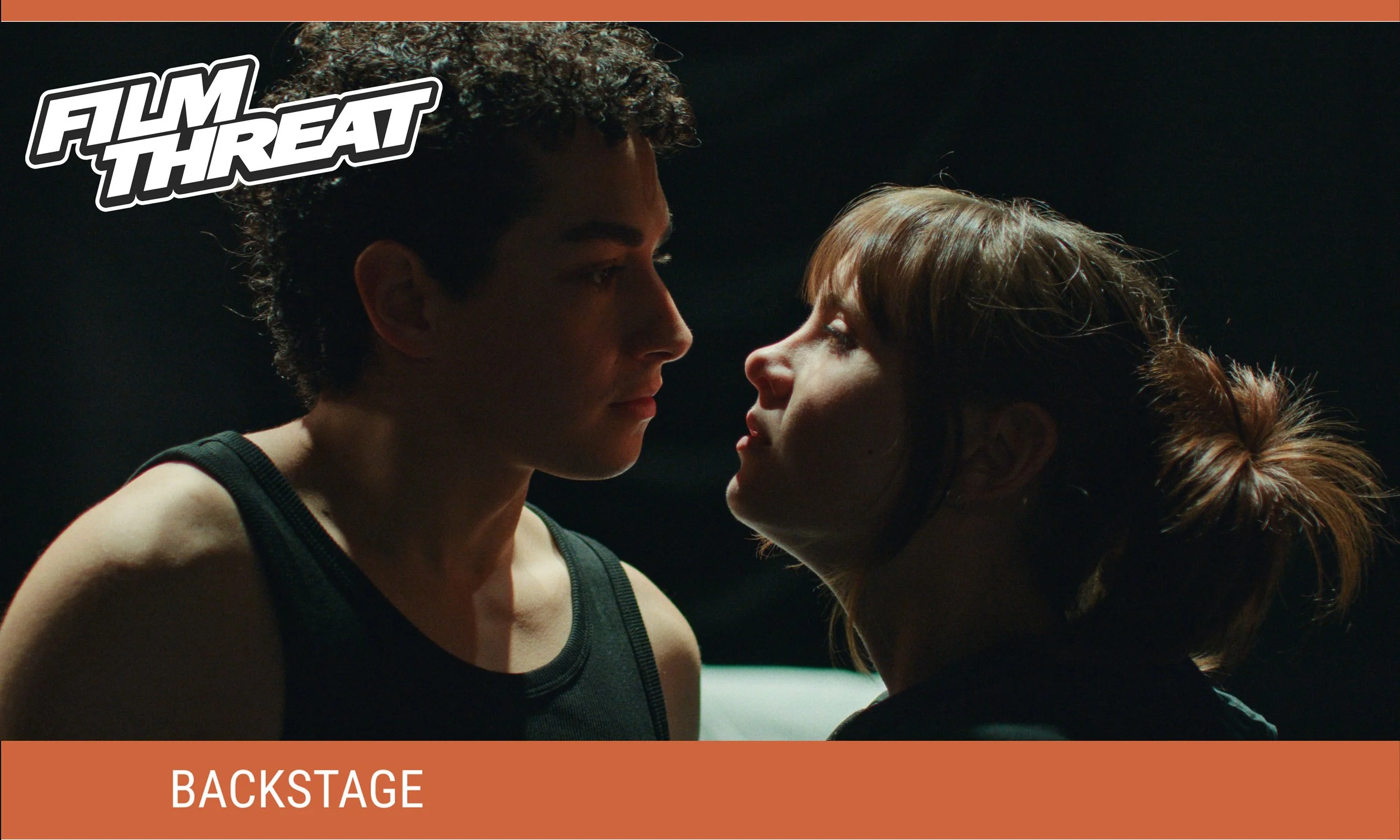
film threat
By benjamin franz
The story, which explores young artists and the manipulative older directors in their lives, is a rich one. In many ways, this is because everybody alive knows such an instructor. In today’s offering, Backstage, writer-director Emile Schlesser explores the tale of a budding young actor and his controlling theater director, Cosima (Sascha Ley). Lukas (Jonathan Joèl Albrecht) is having a wondrous breakthrough role in a two-person play. Cosima is the warm, nurturing, controlling theater director with a secret; she seduces the most talented male actors she works with. Being a cougar, Cosima is very into young men like Lukas.
Backstage is a taut psycho-sexual game of cat and mouse. It’s very clear Cosima is in control of the situation the entire time. No matter what is chosen or selected by Lukas, Cosima will have her way. Either he will bend to her will, or there goes his first star turn. This is a tale as old as time, dear reader. However, because it’s deeply ingrained in human psyches and psychology, it never loses its magnetism. Backstage will have you spellbound for the entire 26 minutes it runs. This is the sort of dynamic fireworks that play out when the artistic personalities clash on the most intimate and sensual arena available: the living theater stage. There on the stage, life is meant to be reproduced in a lovingly exaggerated manner. Live theater, one of my professors would aver, is the most dangerous art form. For it is in that live exchange of physicality and emotion that anything can and will happen.
Such is the situation in Backstage. Lukas is clearly working his heart out. He will symbolically and possibly literally leave everything for the stage and his performance. Cosima, conversely, is doing everything she can to goad and coax the real emotions and physical fervor of Lukas. Time and again, she mentions that she hasn’t seen an actor as talented as him in a long time.
Backstage is a real barnstormer of a theater production. If you like backstage actor dramatics, dear reader, check Backstage out. It will absolutely be worth your time and attention.
Movie score: 9/10
“ Will have you spellbound
for the entire 26 minutes it runs.”
the weekend warrior
by Edward Douglas
Émile V. Schlesser’s 30-minute German-language short film Backstage takes a look at the world of theater and how an inherent power structure leads to awkward situations or much worse.
The movie stars Jonathan Joèl Albrecht as Lukas, a burgeoning young actor preparing for a play called “Python,” trying his best to please the play’s older director Cosima (Sascha Ley). She’s a bit of a cougar, regularly hitting on her significantly younger star. When one of her previous prize pupils, Philippe (Tommy Schlesser), shows up to the theater, Lukas begins feeling like he might be replaced in Cosima’s play, especially if he doesn’t succumb to his director’s advances. In turn, she starts playing the two male actors against each other to maintain her control over Lukas.
It’s often hard to find things to discuss when it comes to short films, especially when the story being told is so clear, concise, and to the point as is Backstage, not leaving a lot of need or room for further dissection. Schlesser is a more than capable filmmaker able to keep the viewer invested in a story that develops and builds over the course of his film.
Although the story mostly focuses on Lukas’ journey, it’s just as much about the dynamics between him and Cosima, the two actors playing them having such terrific scenes together, as their highly toxic relationship leads to all sorts of problems with the play and even Lukas’ female co-star, who gets caught in the middle. It’s an idea that could definitely be relatable to those who work in the arts and have to deal with the idea of being forced into sexual situations to improve their status, something that was brought very much into the spotlight during 2017’s #MeToo movement.
Without giving too much away about where things go, Cosima’s unprofessional behavior comes to a head during opening night when she locks Lukas in his dressing room in retaliation for him pushing her away, leading to one last stand-off.
Ultimately, Backstage is quite a strong short film from Schlesser, showing off a lot of talent, including a cast doing an exemplary job selling its premise. I’d love to see what Schlesser does with a feature, and apparently, he’s in the middle of filming one. I’m sure we’ll be hearing more about him Stateside down the road.
Rating: 8/10

“A strong short film, showing off a lot of talent,
including a cast doing an exemplary job selling its premise.”
“ Masterfully balances moments of playfulness
with considerable emotional depth. ”
filmshortage interview with Émile V. Schlesser
Backstage is a fantastic piece that masterfully balances moments of playfulness with considerable emotional depth. The film takes its time developing its characters and their shifting relationships, allowing the underlying power dynamics to emerge gradually and convincingly.
The performances are a particular highlight. The cast navigates the distinction between theatrical acting and the more intimate on-camera performances with remarkable precision — a difficult balance that is handled exceptionally well. This layering also adds another dimension to the story, as performance itself becomes intertwined with the characters’ real emotions and intentions.
The characters are exceptionally well crafted, with enough nuance and ambiguity to make their relationships feel authentic rather than predetermined. As boundaries begin to blur, the film creates some genuinely gripping moments, carefully balancing attraction, ambition, vulnerability, and control without oversimplifying the dynamic.
Overall, Backstage is a confident and accomplished film, elevated by excellent performances, thoughtful character development, and a compelling exploration of power that leaves a lasting impression.

“A gripping exploration of the abuse of power.”
DIRECTORS NOTEs interview with Émile V. Schlesser
In the theatre, every performance is an illusion. But what happens when the most dangerous drama unfolds beyond the audience’s view?
In Backstage, director Émile V. Schlesser draws on personal experience to take us into the unsettling world behind the curtain, where artistic ambition, attraction and authority become entangled in a perilous psychological game. When a young actor finds his future resting in the hands of a demanding director, the boundaries between mentorship and manipulation begin to dissolve.
The result is a gripping exploration of the abuse of power, vulnerability and the invisible forces that can make saying no feel impossible. Returning to Directors Notes for his third appearance on our pages, Schlesser talks to us about the tight shooting schedule in one of Luxembourg’s prestigious theatres, the crew’s belief in the project and generosity in making the most of the location, and the trust he built with his actors to capture scenes of both intimacy and abuse. He also reflects on the catharsis of co-writing and sharing his story, and offers advice to anyone facing a similar situation.